Penelope Barker
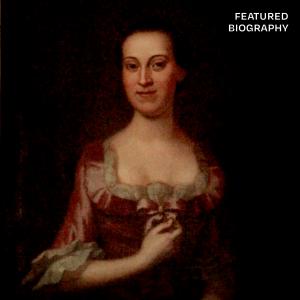
Penelope Barker was the organizer of the Edenton Tea Party, one of the first recorded women’s political demonstrations in America, in which she led fifty women to sign a statement boycotting British imports in support of the Patriot cause.
Widowed twice and separated from her third husband, Barker learned to manage her family’s estate and wielded unusual agency for a woman of the revolutionary era.
“In October 1774, Penelope Barker did what women of her time and social class weren’t raised to do: figuratively, rather than literally, stir the pot.”
Aurora Martínez, Smithsonian Magazine
Early Life
Born in Edenton, North Carolina on June 17, 1728, Barker was one of three daughters of Samuel Padgett, a physician and farmer, and Elizabeth Blount, daughter of wealthy politician and plantation owner James Blount. When she was a teenager, both Baker’s father and older sister Elizabeth died, leaving her to help raise her nieces and nephews.
Barely seventeen years old, Barker married her sister’s widowed husband, John Hodgson, in 1745. Two years later, he died, leaving her with two sons of her own to raise along with the three children from her husband’s previous marriage.
Financial Agency
In 1751, Barker married James Craven, a wealthy planter and political leader. However, she was widowed a second time when Craven died in 1755. After inheriting his entire estate, she became one of the richest women in North Carolina. Two years later, at the age of twenty-seven, she married Thomas Barker, an Edenton attorney 16 years her senior. The couple had three more children; however, none survived past infancy. In 1761, her husband left for England as an agent of the North Carolina colony, however he was unable to return for seventeen years due to the American Revolution and British blockade. In the meantime, Baker managed their estates and household (Martin, Michael G.).
While women of the colonial period, especially married women, were rarely able to own and manage their own property, Barker was accustomed to managing her family’s affairs without the help of a husband (Smithsonian Magazine). Barker had become a formidable woman and a leader in her community. She used her business and organizing skills to support the Revolutionary cause, integrating women as active participants.
Edenton Tea Party
Throughout the colonies, Patriot leaders urged women, in their role as consumers, to support the rebellion by boycotting British imports such as cloth and tea. This was in keeping with the non-importation resolutions passed by the First Continental Congress in 1774. The move was made in response to the 1773 Tea Act, passed by Parliament, which gave the British East India Tea Company a monopoly in the colonies and was the last in a series of taxes and policies that colonists fiercely resented.
On October 25, 1774, Barker gathered fifty women, possibly in the home of Elizabeth King, where they signed a resolution supporting the boycott (Smithsonian Magazine). The event—dubbed the Edenton Tea Party—was the first recorded women’s political demonstration in America (North Carolina History). Their resolution stated:
“We, the aforesaid Ladys will not promote ye wear of any manufacturer from England until such time that all acts which tend to enslave our Native country shall be repealed.”
Smithsonian Magazine
The resolution, along with the names of all fifty-one women, was published in the Virginia Gazette on November 3, 1774, by renowned female publisher Clementina Rind. By 1775, word had travelled across the Atlantic and appeared in London newspapers.
Many of the women who were part of this demonstration were married to prominent figures in the Edenton, North Carolina community, such as politicians, lawyers, doctors, merchants, and plantation owners. Other than Barker, most White, upper-class women did not hold financial power in their households. Rather, married women were often responsible for deciding which products and goods to stock in the house, what to serve for the family, and how to entertain guests. By boycotting tea, which was a ubiquitous item in everyday Colonial life, they were using the everyday tools that they had access to in order to express their political ideas (Smithsonian Magazine).
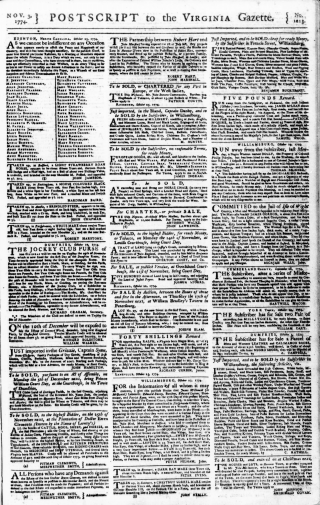
Figure 1. “Edenton, North Carolina October 25, 1774.” Virginia Gazette, November 3, 1774. Colonial Williamsburg.
While the women’s efforts were applauded in the colonial press, London papers mocked them. In a now-famous political cartoon of the Edenton Tea Party published in the London press, the women are shown as bad mothers and women of loose morals. A Black enslaved woman is in the background of the image, referencing these women’s backgrounds as the wives of plantation owners. At the time, imagery of Black people working as servants represented extreme luxury, and her presence supports the argument that the participants in the Edenton Tea Party were frivolous and wealthy ladies (Davydeen, David). Today, she is a reminder that Barker’s wealth and influence came from a plantation; an influence which she utilized to argue for a liberty and freedom that was denied to the fifty-three people enslaved by her and her family (Smithsonian Magazine).
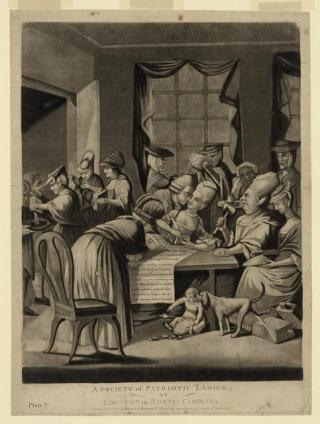
Figure 2. Robert Sayer and John Bennett (Firm), and Philip Dawe. Mezzotint. 1775. A society of patriotic ladies, at Edenton in North Carolina. London: Printed for R. Sayer & J. Bennett. British Cartoon Prints Collection, Library of Congress Prints & Photographs Online Catalog. http://www.loc.gov/pictures/item/96511606/
Baker continued the boycott throughout the war. After her husband returned in 1778, she had no documented political involvement in the Early Republic. Little is known about her later life. The resolution of those fifty-one women, organized by Barker, slipped into obscurity until the mid-19th-century, when American naval officer from Edenton, William T. Muse, found the satirical cartoon in a barbershop on the island of Minorca (Smithsonian Magazine). This random encounter sparked local historical interest for the following century in the Edenton Tea Party, enabling historians to study Barker’s life and political actions today.
 Primary Source Analysis Strategies

Figure 1. “Edenton, North Carolina October 25, 1774.” Virginia Gazette, November 3, 1774. Colonial Williamsburg. Accessed June 10, 2026.
-
This source, with transcription, is the statement by the Edenton Tea Party participants, fifty-one women who resolved to boycott English imports in protest of English rule. What, based on the text, was the intended outcome of their action?
-
How does the Edenton Tea Party differ from the Boston Tea Party? What do you think are the causes for these differences?
-
In what ways is the Edenton Tea Party significant for women’s political participation in the American Revolution?
Figure 2. Robert Sayer and John Bennett (Firm), and Philip Dawe. Mezzotint. 1775. A society of patriotic ladies, at Edenton in North Carolina. London: Printed for R. Sayer & J. Bennett. British Cartoon Prints Collection, Library of Congress Prints & Photographs Online Catalog. http://www.loc.gov/pictures/item/96511606/
-
This is a satirical image of the Edenton Tea Party which you have read about in this biography of Penelope Barker. Looking at this image, what do you see in the scene? Who are the people in the scene, what are they doing, and how are they interacting with each other?
-
What point do you think this satirist is making about the Edenton Tea Party? Use three pieces of visual evidence to support your claim.
Collins, Gail. America’s Women: Four Hundred Years of Dolls, Drudges, Helpmates, and Heroines. New York: HaperCollins, 2003.
Davydeen, David. Hogarth's Blacks: images of Blacks in eighteenth century English art. Athens: University of Georgia Press, 1987.
“Edenton Tea Party.” North Carolina History Project. Accessed February 10, 2015.
Garrison, Webb. Great Stories of the American Revolution: Unusual, Interesting Stories of the Exhilarating Era When a Nation was Born. Rutledge Hill Press, 1993.
Martin, Michael G., Jr. “Barker, Penelope.” NcPedia. Accessed February 10, 2015. https://www.ncpedia.org/biography/barker-penelope.
Martínez, Aurora. “To Protest British Taxes, Men Dumped Tea Into Boston Harbor. With the Edenton Tea Party, Colonial Women Took a Different Approach.” Smithsonian Magazine. August 22, 2025. https://www.smithsonianmag.com/history/to-protest-british-taxes-men-dumped-tea-into-boston-harbor-with-the-edenton-tea-party-colonial-women-took-different-approach-180987189/.
“North Carolina.” Landmarks of the American Revolution: Library of Military History. Ed. Mark M. Boatner, III. 2nd ed. Detroit: Charles Scribner's Sons, 2006. 247-273. U.S. History in Context. Accessed February 10, 2015.
“Penelope Barker.” Edenton-Chowan County Tourism Development Authority. Accessed February 8, 2015.
Silcox-Jarrett, Diane. “Penelope Barker, Leader of the Edenton Tea Party,” in Heroines of the American Revolution, America’s Founding Mothers. Chapel Hill, North Carolina: Green Angle Press, 1998.
Stroup, Jane Shaw. “Penelope Barker (1728-1796).” North Carlnea History. Accessed June 10, 2026. https://northcarolinahistory.org/encyclopedia/penelope-barker-1728-1796/.
Image credit
Museum of History, Office of Archives and History, N.C. Department of Natural and Cultural Resources.
MLA — “Penelope Barker.” National Women's History Museum. National Women's History Museum, 2015. Revised 2026. Date accessed.
Chicago — “Penelope Barker.” National Women's History Museum. 2015. Revised 2026. www.womenshistory.org/education-resources/biographies/penelope-barker.
Web Sites:
“A Society of Patriotic Ladies at Edenton in North Carolina”
“Penelope Barker: First American Woman Political Activist”
Books:
Silcox-Jarrett, Diane. “Penelope Barker, Leader of the Edenton Tea Party,” in Heroines of the American Revolution, America’s Founding Mothers (Chapel Hill, North Carolina: Green Angle Press, 1998).
Martha Washington
Dolley Madison
Abigail Smith Adams